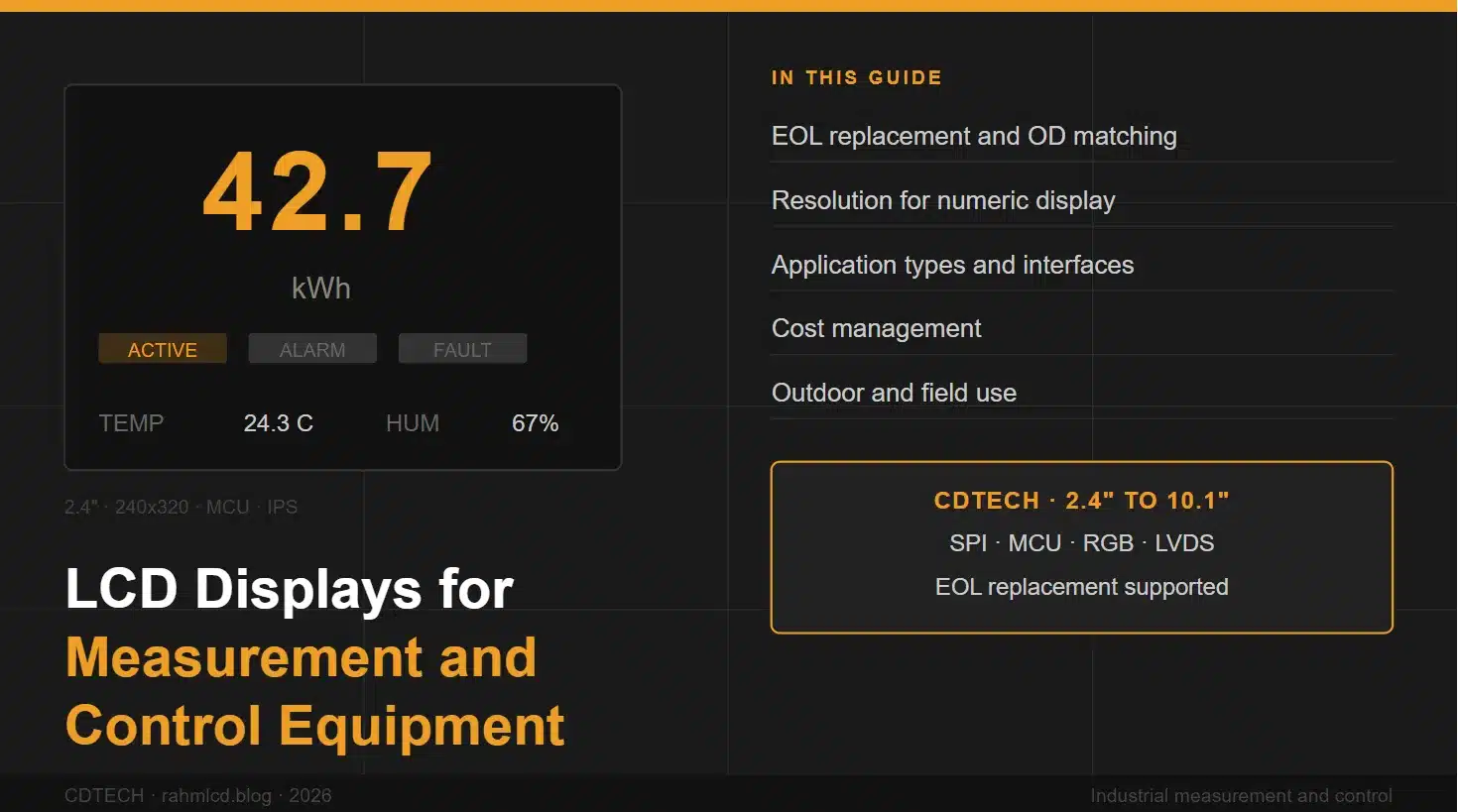
Measurement instruments and industrial controllers are not where display selection gets glamorous. The screens are small, the UI is dense, and the enclosure cutout was designed around a module that may have been discontinued three years ago. The requirements are specific, the volumes are modest, and the margins are tight.
But the display is still the primary interface between the device and the operator. A numeric readout that is hard to read under fluorescent lighting, or a touchscreen that fails to register in a cold warehouse, makes the instrument worse regardless of how accurate the underlying measurement is. This article covers the display-related decisions that come up most often in this segment. For a general overview of TFT LCD module types and configuration options, see our complete TFT LCD module guide.
What makes measurement and control displays different
Three characteristics separate this segment from general industrial displays.
First, the display is usually small. Energy meters, heat network monitors, building controllers, and handheld test instruments typically use displays in the 2.4 to 5 inch range. At these sizes, the resolution per inch matters more than the raw resolution number. A 2.4 inch display at 240×320 and a 4.3 inch display at 480×272 both have relatively low resolution, but the smaller panel needs to render the same number of characters in a smaller space. Font rendering quality and pixel density directly affect whether numeric readouts are legible in field conditions.
Second, the outer dimensions are often fixed. Measurement instruments are designed around existing enclosures, DIN rail form factors, or panel cutout standards. The replacement display needs to fit the mechanical envelope precisely. A few millimeters of difference in the outer dimensions or the active area position can mean the device cannot be reassembled. This makes OD dimension matching a hard constraint rather than a preference.
Third, the segment is price-sensitive. Many measurement instruments are deployed in large quantities into infrastructure projects in price-sensitive markets. Energy meters, heat network monitors, and building controllers are often bought in volumes of thousands, and the display cost is scrutinized accordingly. This does not mean quality is sacrificed, but it does mean the cost structure of any custom or replacement solution needs to be justified clearly.
EOL replacement is the most common reason to re-specify a display
Measurement instruments have long field lives. An energy meter installed in 2018 may still be in active production in 2026. If the display module specified for that meter goes end-of-life, the manufacturer faces a choice: find a replacement that fits the existing mechanical and electrical design, or redesign the product around a new display.
The second option is expensive and slow. Most manufacturers try to find a replacement first.
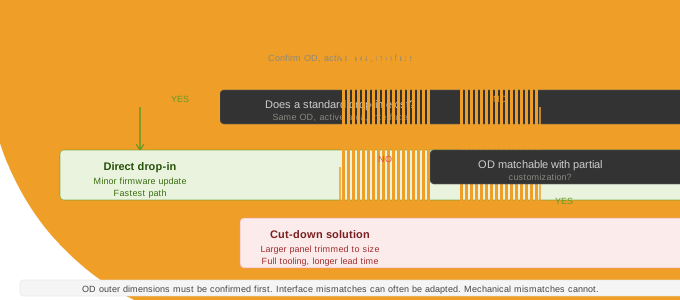
The challenge is that measurement instrument displays often use non-standard configurations. A specific active area size, a particular FPC exit direction, or a backlight arrangement that was common in 2016 may not correspond to anything in current standard production. Finding a replacement that matches the OD dimensions, the active area, the interface pinout, and the backlight configuration simultaneously is not always possible from catalogue stock.
When a direct drop-in does not exist, the options are a partial customization, changing only the components that differ while keeping the rest of the module standard, or a cut-down solution based on a larger standard panel trimmed to the required active area. Both involve NRE cost and tooling lead time. For a full breakdown of how EOL replacement projects work and what to prepare, see our guide on LCD display EOL replacement.
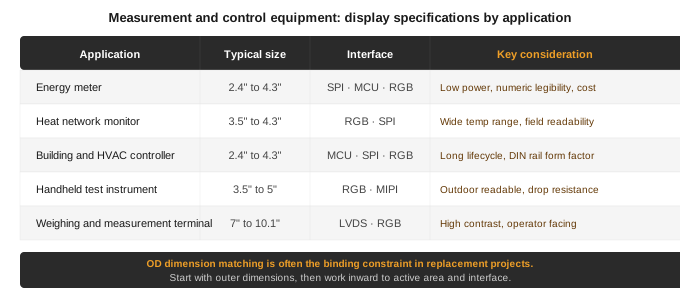
Application types and typical display specifications
| Application | Typical size | Interface | Key consideration |
|---|---|---|---|
| Energy meter | 2.4″ to 4.3″ | SPI · MCU · RGB | Low power, numeric legibility, cost |
| Heat network monitor | 3.5″ to 4.3″ | RGB · SPI | Wide temperature range, field readability |
| Building and HVAC controller | 2.4″ to 4.3″ | MCU · SPI · RGB | Long lifecycle, DIN rail form factor |
| Handheld test instrument | 3.5″ to 5″ | RGB · MIPI | Outdoor readable, drop resistance |
| Industrial sensor with display | 0.96″ to 3.5″ | SPI · I2C | Very small, numeric only |
| Weighing and measurement terminal | 7″ to 10.1″ | LVDS · RGB | High contrast, operator facing |
Resolution and pixel density for numeric display
Measurement instruments display numbers, units, and status indicators. The UI is not graphically complex, but it is dense. A 4.3 inch energy meter front panel may need to show three or four rows of data simultaneously in a font size that is readable from arm’s length.
At small display sizes, the choice between resolution options matters more than it might seem. A 4.3 inch panel at 480×272 gives a pixel density of roughly 128 PPI. The same size at 800×480 gives about 216 PPI. For purely numeric display at small sizes, 800×480 renders characters noticeably more crisply, particularly for digits like 1, 7, and 4 where fine vertical lines define readability.
The practical limit is the host processor. Pushing 800×480 over a parallel RGB interface at full frame rate requires more bandwidth than 480×272. For low-power MCU designs with limited GPIO, the lower resolution is often the right choice even if the higher resolution would look better. Confirming that the host can drive the target resolution before specifying the panel avoids a mismatch that is expensive to fix after PCB layout is complete.
A real project: building controller in long-term production
One of the projects we have supported over multiple years involves a 2.4 inch display used in a building automation controller deployed across multiple markets in Europe. The application is a DIN rail mounted HVAC and building control module used in commercial installations.
The display specification has been stable across production batches, but the project has involved several rounds of re-qualification as component availability shifted. The product requires consistent brightness and color uniformity across batches, because installations often include multiple units visible simultaneously in the same panel. Batch-to-batch variation that would be acceptable in a single-unit application becomes visible when units are mounted side by side.
The key learning from this type of long-lifecycle project: locking the display specification early and maintaining a stable supply relationship with the module manufacturer reduces the re-qualification overhead significantly compared to switching suppliers between production runs. Each supplier change requires validating brightness, viewing angle, and interface compatibility again, which takes time and engineering resources that small-volume instrument manufacturers typically do not have in surplus.
Managing cost in price-sensitive markets
Energy meters, heat monitors, and building controllers are frequently deployed into infrastructure projects where the device is one line item in a large bill of materials. The display cost is scrutinized against the total device cost, and there is often a target price that the display needs to fit within regardless of what the engineering team prefers.
A few approaches that work in practice:
Standard catalogue modules where the specification fits. Custom tooling adds NRE cost that rarely makes sense below a few thousand units per year. If a standard 4.3 inch module meets the size, interface, and resolution requirements, it is almost always the lower total cost option even if it requires minor firmware adaptation.
Separating NRE from unit cost in the conversation. A display supplier that quotes a bundled price for samples and tooling without breaking down which cost is which makes it difficult to evaluate whether custom work is justified. An itemized NRE covering only the components that actually need tooling, such as a backlight FPC modification rather than a full mechanical redesign, is often much lower than a blanket custom quote implies. For more on how custom LCD cost structures work, see our guide on custom LCD display OEM evaluation.
Volume commitment and annual pricing. For products with predictable annual volumes, a committed annual quantity often unlocks unit pricing that brings the display cost within range without requiring a lower-spec panel. A 10k per year commitment priced as 10k is meaningfully different from the same volume ordered as ten separate 1k batches.
Outdoor and field-use considerations
Handheld test instruments and field-mounted measurement equipment face ambient light conditions that benchtop or panel-mounted devices do not. A clamp meter being used on a rooftop switchgear cabinet in direct sun, or a flow meter mounted on an outdoor pipe, needs a display that remains readable without the operator shading it with their body.
For handheld instruments, 500 to 800 nits covers most outdoor industrial conditions. For permanently mounted outdoor field devices, higher brightness combined with anti-reflective surface treatment is more reliable than brightness alone. The anti-reflective coating reduces the ambient light reflected back at the operator, which effectively improves contrast without increasing power consumption. For a detailed breakdown of outdoor readability thresholds, see our guide on sunlight readable LCD displays.
What to confirm before specifying a measurement instrument display
- If this is a replacement for an existing module: what are the outer dimensions, active area, interface pinout, and backlight configuration of the original? OD matching is the first constraint.
- What resolution does the host processor support natively, and what interface does it output?
- Is the display used indoors under controlled lighting, or in field conditions with variable ambient light?
- What is the expected annual production volume, and does it justify any custom tooling cost?
- What is the product’s expected production lifecycle? A display module with a shorter lifecycle than the product creates an EOL problem in the future.
- Is batch-to-batch consistency a requirement? If multiple units are visible simultaneously in the same installation, brightness and color uniformity specifications matter more than in single-unit applications.
Working on a measurement instrument or industrial controller display specification? Share the application, display size, and any EOL replacement requirements. We can confirm module availability and give you a realistic cost and lead time estimate. Contact us here.

 English
  Español
  日本語
日本語  한국어
한국어
Leave a Reply