Vehicle display projects take longer than most engineers expect. The technical requirements are more specific, the certification process is more demanding, and the decision chain involves more stakeholders than a typical industrial project. A display module that works perfectly on a bench may fail a vibration test, a thermal shock test, or a power-on cycling test before it ever reaches a vehicle.
This article covers the display-related issues that come up in vehicle applications, from two-wheeled vehicles and agricultural machinery to passenger car center consoles. For a general overview of TFT LCD module specifications, see our complete TFT LCD module guide.
Environmental requirements and certification standards
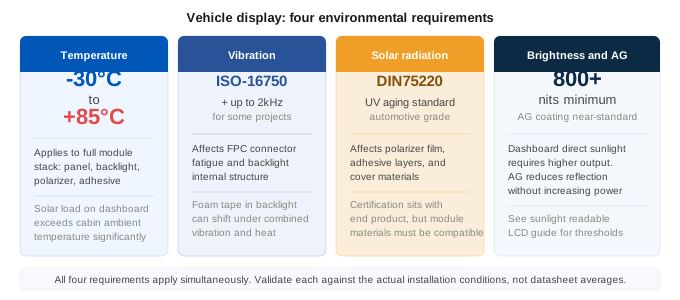
Vehicle displays face a combination of stresses that industrial displays do not encounter together. Temperature range, vibration, and solar radiation all apply simultaneously, and all must be validated rather than assumed.
Temperature range
The standard operating range for vehicle displays is -30°C to 75°C, with some projects requiring -30°C to 85°C. This range is not just the ambient air temperature. It includes the thermal load from solar radiation on the dashboard, which can drive surface temperatures significantly higher than the cabin air temperature. A display installed in a dashboard cutout facing direct sunlight needs to be specified against the actual surface temperature at that location, not the cabin thermostat setting.
The temperature range applies to the entire module stack: panel, backlight, polarizer, adhesive layers, and any bonded cover glass. Each component has its own thermal limit, and the effective limit for the module is the lowest of those. Backlight and polarizer specifications sometimes have different upper limits, and this matters when the module is under sustained solar load.
Vibration
ISO-16750 defines vibration and shock requirements for road vehicle electronics. For display modules, vibration primarily affects two things: the fatigue life of the FPC connector and the structural integrity of the backlight assembly. Both can pass initial inspection and fail after extended exposure to the vibration profile defined in the standard.
Some projects specify 2kHz high-frequency vibration requirements on top of the standard ISO-16750 profile. This is more demanding than typical industrial vibration specifications and requires specific validation. If a project has this requirement, it should be disclosed to the display supplier at the start of the design phase, not after samples have been produced.
Solar radiation: DIN75220
DIN75220 defines solar radiation aging procedures for automotive components. This standard matters for polarizer films, adhesive layers, and cover materials that face direct or indirect sunlight over the vehicle’s service life. The certification sits with the end product, not the display module itself, but the materials used in the module need to be compatible with passing that certification. This is worth confirming with the supplier before the design is finalized. For more on outdoor brightness and solar radiation in display applications, see our guide on sunlight readable LCD displays.
Brightness and anti-glare
800 nits is the practical minimum for vehicle displays that face any ambient light. Dashboard-mounted displays under direct sunlight need more. Anti-glare surface treatment is nearly standard for vehicle applications: an untreated glass surface reflects enough ambient light to wash out the display under typical driving conditions, regardless of backlight brightness.
Power-on sequence: the most common debugging issue in vehicle display integration
This problem comes up repeatedly in vehicle display projects, and it is almost always diagnosed late because the symptom looks like a hardware fault when it is actually a firmware configuration issue.
The symptom: after sleep or power cycling, the display shows a corrupted image or goes blank. Restarting the system restores normal operation. The problem occurs intermittently, more often at high temperatures.
The cause: the power-on and power-off sequence for the LCD module is not being followed correctly by the host system. LCD modules require specific voltage ramp sequences for VGH, VGL, and VCOM. If the host brings these voltages down or up in the wrong order, the display driver IC enters an indeterminate state. The display appears to work normally in most cases but fails intermittently, especially when thermal stress changes the timing margins.
The fix: implement the power-on and power-off sequence exactly as specified in the module datasheet. Do not borrow the sequence from a different module or a previous project. Different panels, even from the same manufacturer, may have different timing requirements.
Vehicle-grade projects typically require this to be validated with a high-temperature cycling power-on test, often ten thousand or more on/off cycles at the upper operating temperature limit. This test should be run before the design is locked, not after trial production has started.
OCA optical bonding in high-temperature environments
Full optical bonding between the LCD panel and the cover glass is standard practice in vehicle display applications. It reduces internal reflections, improves outdoor readability, and increases resistance to shock and vibration. But the bonding process introduces its own failure modes that are specific to high-temperature vehicle environments.
Bubble formation after thermal cycling
OCA adhesive can develop bubbles after thermal cycling if the adhesive grade is not suited to the operating temperature range. This is a material selection issue, not a bonding process defect. Consumer-grade OCA adhesive is formulated for room-temperature and moderate-temperature applications. Vehicle-grade OCA has higher temperature tolerance and different flow characteristics under thermal load.
Bubbles that are invisible at room temperature can appear or grow after thermal shock cycling. If this is going to happen, it will happen in thermal testing. Running thermal shock tests on bonded samples before committing to trial production is the only reliable way to catch this.
Edge delamination and warping
Differences in thermal expansion coefficient between the glass, adhesive, and polarizer layers can cause the display stack to warp at high temperatures. This typically shows up as edge lifting or separation at the corners of the display area. The bonding sequence, meaning which layer is bonded first, affects the direction and magnitude of the warping. This is a process parameter that needs to be established and validated for each specific material combination, not assumed to be the same as a previous project.
Display sizes and interfaces in vehicle applications
| Vehicle type | Typical application | Common size | Interface |
|---|---|---|---|
| Two-wheel and three-wheel | Instrument cluster, dashboard | 3.5″ to 5″ | RGB · MIPI |
| Passenger car | Center console, infotainment | 7″ to 12.8″ | LVDS · HDMI |
| Commercial vehicle, bus | Center console, rear-view display | 7″ to 12.3″ | LVDS · HDMI |
| Agricultural machinery | Cab control system | 7″ to 10.1″ | LVDS |
| Special vehicles | Instrument cluster, status display | 5″ to 8.8″ | LVDS · MIPI |
Bar-type LCD formats appear frequently in instrument cluster applications, where the display needs to fit within a narrow horizontal band. An 8.8 inch 1920×480 bar LCD, for example, provides enough resolution for a full-width instrument display while fitting within the height constraints of a typical instrument panel. For a detailed breakdown of bar LCD sizes and interfaces, see our stretched bar LCD sizing guide.
Touch panel technology in vehicle applications follows the same logic as industrial: capacitive touch for clean-hand operation, with glove mode configured correctly for environments where operators wear gloves. For vehicle applications with high EMI from motor systems, touch controller sensitivity tuning is worth confirming before production. Our guide on capacitive vs resistive touch panels covers this in detail.
The certification process and project timeline
Vehicle display projects have a longer and more structured qualification process than industrial projects. Understanding what is involved helps set realistic expectations for both the engineering team and procurement.
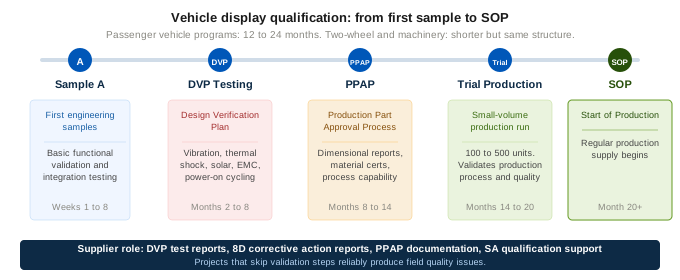
The typical sequence for a passenger vehicle center console display:
- Sample A: first engineering samples, used for basic functional validation and initial integration testing.
- DVP (Design Verification Plan): structured testing against the full set of environmental and reliability requirements. Vibration, thermal shock, solar radiation, EMC, power-on cycling. This phase produces test reports that the vehicle manufacturer reviews before approving the supplier.
- PPAP (Production Part Approval Process): documentation package confirming the production process is capable of consistently producing parts that meet the specification.
- Trial production: a small-volume production run used to validate the production process before full SOP.
- SOP (Start of Production): the display enters regular production supply.
From first sample to SOP, this process typically takes twelve to twenty-four months for passenger vehicle applications. Two-wheel and agricultural machinery projects can move faster, but the DVP phase is still present.
The display supplier’s role in this process extends beyond delivering parts. Supporting DVP testing with test reports and failure analysis, providing 8D corrective action reports when issues arise, and maintaining documentation traceability are all part of what vehicle-grade supply means in practice. We have supported projects through this full qualification cycle, including DVP sample evaluation, thermal and vibration testing, PPAP documentation, and SA qualification.
What to confirm before locking a vehicle display specification
- What is the operating temperature range at the installation location, including solar radiation load on the display surface?
- What vibration standard applies, and is there a high-frequency requirement above the standard ISO-16750 profile?
- Has the power-on and power-off sequence been confirmed against the module datasheet, and has high-temperature power cycling been validated?
- Is optical bonding required? If so, has the OCA adhesive grade been validated through thermal shock testing?
- What certification documentation is required: PPAP, 8D reports, third-party test reports?
- What is the expected product lifecycle, and is the display module’s production lifecycle confirmed to cover it? For modules approaching EOL, see our guide on LCD display EOL replacement.
Working on a vehicle display project? Share the application, display size, temperature range, and certification requirements. We can recommend a module configuration and confirm what test documentation we can provide.
Related Resources

 English
  Español
  日本語
日本語  한국어
한국어
Leave a Reply