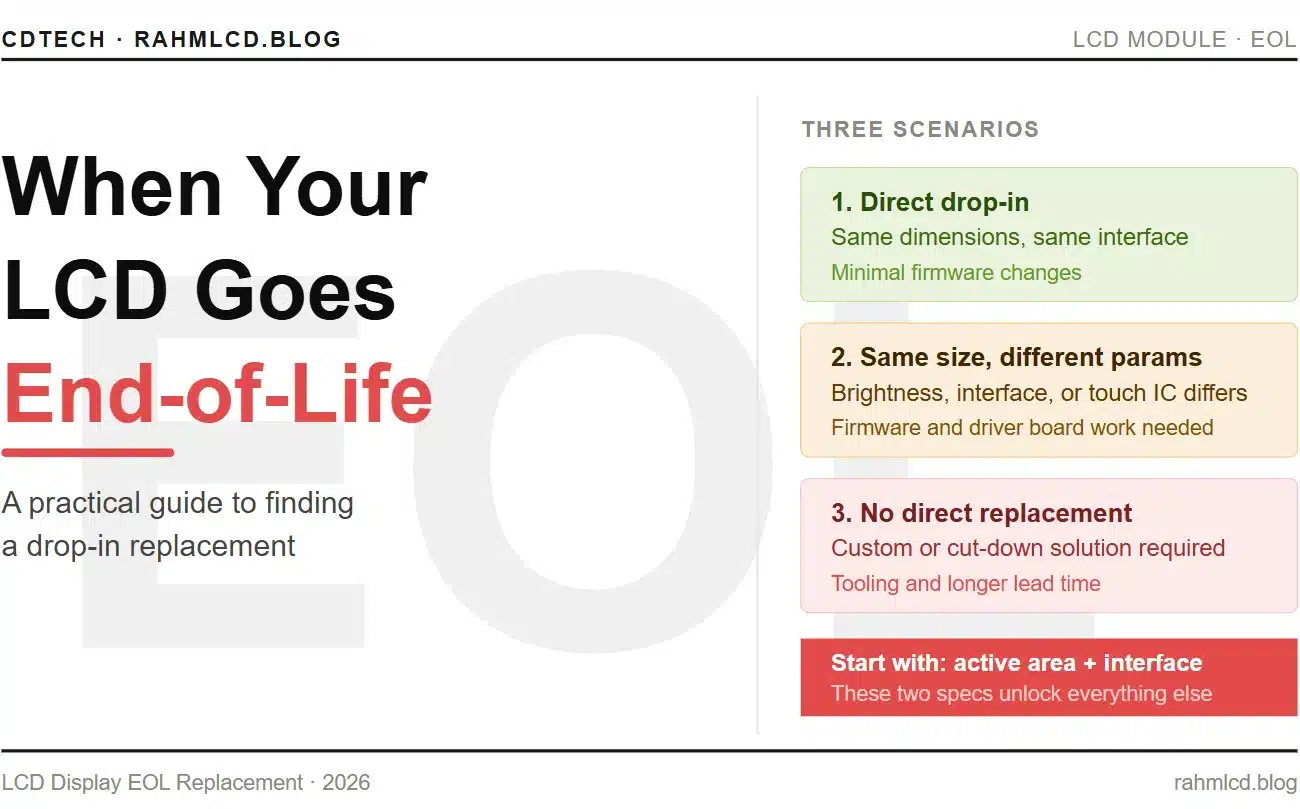
The notification arrives without much warning. The display module your product has been using for three years is going end-of-life. The panel manufacturer is stopping production, and your current supplier cannot offer a last-time buy large enough to cover your remaining product lifecycle. You now have a window, usually six to twelve months, to find a replacement and re-qualify it before your production line stops.
This is one of the most common situations we handle. Most of our EOL replacement work comes from industrial and vehicle-mounted applications, where product lifecycles are long and display components are deeply integrated into certified enclosures and validated firmware stacks. The pressure is real, and the margin for error is low.
Why LCD modules go EOL in the first place
Most people assume EOL means the manufacturer decided to stop selling a product. In practice, the trigger usually comes from further up the supply chain. Understanding the root cause helps you find the right solution faster.
Cause 1: glass substrate discontinuation
TFT glass comes from a small number of suppliers. Each major glass manufacturer typically runs two or three parallel production lines across different facilities. These lines produce the same glass generation.
When supply conditions deteriorate at one facility, that line may shut down. But the identical glass often continues at another location. In this case, the EOL is a sourcing transition, not a true discontinuation. The module can be rebuilt using glass from the alternative line.
The change is usually invisible at the module level. The main cost is an FPC retooling fee. Minor dimensional tolerances between facilities often require a revised flex circuit, but the active area and interface stay the same.
We are currently handling exactly this situation with one of our 10.1 inch modules. We are transitioning it from a discontinued glass to a replacement from the same manufacturer’s newer generation line. The customer’s mechanical and electrical integration does not need to change. Only the part number updates.
The harder scenario is when a glass generation is discontinued across all facilities at once. In that case, every module built on that glass goes EOL simultaneously. This is why multiple unrelated display models sometimes stop production at the same time.
Cause 2: driver IC discontinuation
The driver IC translates video signals into pixel-level instructions. It is often a custom or semi-custom part made in limited production runs.
When the IC fab stops supporting a specific part number, the module cannot be produced without redesigning around a new IC. That is a significant engineering effort. Most module manufacturers will not take it on for a low-volume product.
IC-driven EOL tends to be harder to resolve than glass-driven EOL. The interface or initialization sequence on any replacement is likely to differ, which means firmware work on the customer side.
The three types of replacement situation
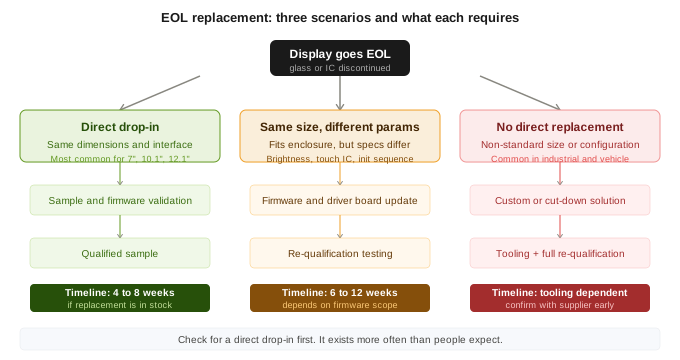
1. Direct drop-in replacement
This is the best outcome. The replacement module has the same dimensions, the same interface pinout, and compatible electrical characteristics. Firmware changes are minimal. Re-qualification is straightforward.
Direct drop-ins exist more often than people expect. They are most common for standard sizes like 7 inch, 10.1 inch, and 12.1 inch in standard aspect ratios. Always check for a drop-in first before assuming custom work is needed.
2. Same dimensions, different parameters
More common than a perfect drop-in. The replacement fits the mechanical envelope, but some parameters differ. The enclosure stays the same, but firmware or the driver board may need updates.
The parameters that most often differ:
- Backlight brightness and power consumption. A different nits value may require adjusting the backlight driver circuit.
- Initialization sequence. Modules with the same interface type often need different register settings at startup. If firmware does not handle this, the display will not initialize correctly.
- Touch controller IC. The replacement touch IC may use a different I2C address or protocol, requiring driver updates.
- Viewing angle. A switch from TN to IPS changes how the display looks from off-axis angles. For fixed mounting positions, this may or may not matter.
3. No direct replacement available
This happens more often in industrial and vehicle applications. The original module used a non-standard active area or a proprietary glass size. No standard replacement exists.
Two approaches work here. The first is finding the closest standard module and working through the mechanical and electrical differences with the engineering team. The second is a cut-down solution: trimming a larger standard panel to the required active area. This needs tooling for the backlight and frame, but avoids the cost of a fully custom glass design. For active areas close to a standard size, it is often the fastest path to a qualified replacement.
What to prepare before contacting a replacement supplier
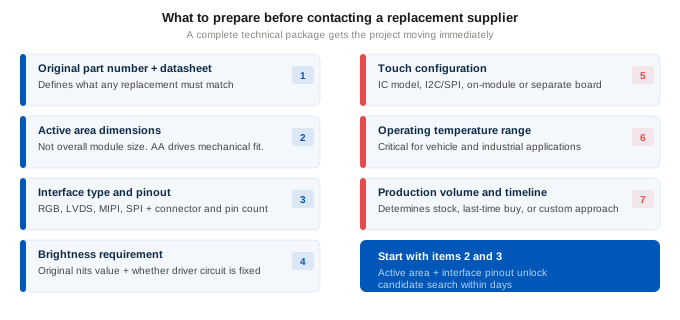
The information you bring to the first conversation determines how fast the project moves. A complete technical package lets a supplier begin evaluation immediately. Missing specs lose weeks.
- The original part number and datasheet. Even for EOL modules, the datasheet defines what any replacement must match.
- Active area dimensions, not overall module dimensions. Active area drives the optical and mechanical fit. Overall dimensions can vary between modules with the same active area.
- Interface type and pinout. RGB, LVDS, MIPI, or SPI, plus connector type and pin count. If the datasheet is gone, recover this from the driver board schematic.
- Brightness requirement. The original nits value, and whether the backlight driver circuit is fixed or adjustable.
- Touch configuration. Touch IC model, communication interface, and whether the controller is on the module or a separate board.
- Operating temperature range. Critical for vehicle and industrial applications where thermal conditions may exceed standard commercial ratings.
- Production volume and timeline. This determines whether standard stock, a last-time buy, or a custom solution is the right approach.
The timeline reality
EOL replacement projects almost always take longer than planned. Two reasons.
First, technical evaluation takes time. Sample procurement, firmware integration, and functional testing each have lead times that do not compress easily.
Second, EOL notifications arrive later than expected. By the time the customer acts, the runway is shorter than it looks.
For a straightforward drop-in with minor firmware changes, four to eight weeks from first contact to qualified sample is realistic if the replacement is in stock. For cut-down or custom solutions requiring tooling, our TFT LCD module guide covers component lead times in detail.
What to ask a potential replacement supplier
- Do you have a standard module with the same active area and interface, or does this require custom work from the start?
- What is the sample lead time? Are evaluation samples available before committing to production volume?
- If the initialization sequence differs, can you provide reference firmware or register settings?
- What is the expected production lifecycle of the replacement? A short-lifecycle replacement creates the same problem in two years.
- If touch is required, can the replacement use the same controller IC, or will firmware changes be needed?
For industrial and vehicle applications, the touch panel choice on a replacement module may need re-evaluation. Our guide on capacitive vs resistive touch panels covers the key decision points. For the full specification picture on industrial display replacements, see our industrial touch screen monitor guide.
Summary
EOL display replacement is rarely a simple part swap. The root cause, glass or IC, shapes what options are available. The three scenarios each require a different approach and timeline.
Projects that resolve quickly share two things: a complete technical package at the start, and enough time for proper sample evaluation. Projects that run into trouble usually started the conversation too late, or assumed specifications instead of confirming them.

 English
  Español
  日本語
日本語  한국어
한국어
Leave a Reply