A TFT LCD module is not a panel. That distinction matters more than it might seem. A bare TFT LCD panel is a component, it requires a backlight, a driver board, an FPC connection, and typically a cover lens or touch panel before it becomes something you can integrate into a product. A module is the assembled combination of these elements, configured and tested to work together, ready for integration into your enclosure.
This guide covers what goes into a TFT LCD module, how the key specifications map to real application requirements, and what to confirm with a supplier before committing to a design. It is written for engineers and procurement teams specifying modules for volume production, not for hobbyist single-unit purchases.
What a TFT LCD module actually contains
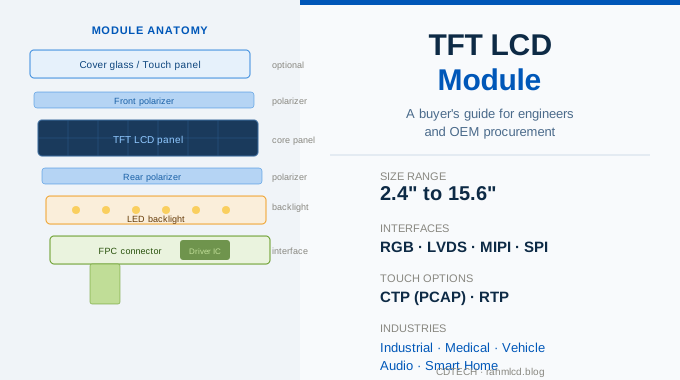
The core of any TFT LCD module is the thin-film transistor panel itself: a matrix of transistors controlling individual pixels, with liquid crystal layers and color filters producing the image. Around that panel, a complete module adds:
- A backlight assembly, typically LED-based, providing the illumination that passes through the liquid crystal layer.
- A polarizer stack, front and rear, which controls the orientation of light passing through the panel.
- A flexible printed circuit (FPC) connecting the panel to the driver IC and the host system interface.
- A driver IC, which translates the incoming video signal into the pixel-level instructions the panel requires.
- Optionally: a touch panel (capacitive or resistive), a cover lens, optical bonding adhesive, and a metal or plastic bezel frame.
The configuration of these elements determines the module’s interface, brightness, viewing angle, touch capability, and mechanical dimensions. Changing any one of them after tooling is expensive. This is why the specification conversation with a supplier matters more than it might seem at first.
The interface question comes first
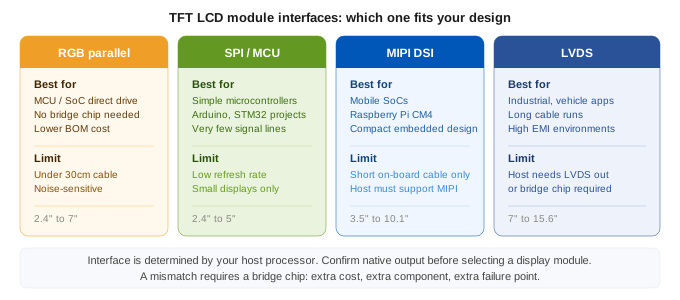
Before brightness, before touch, before anything else: the interface between the module and the host system determines what is even possible in your design.
| Interface | Typical use case | Cable length | Common sizes |
|---|---|---|---|
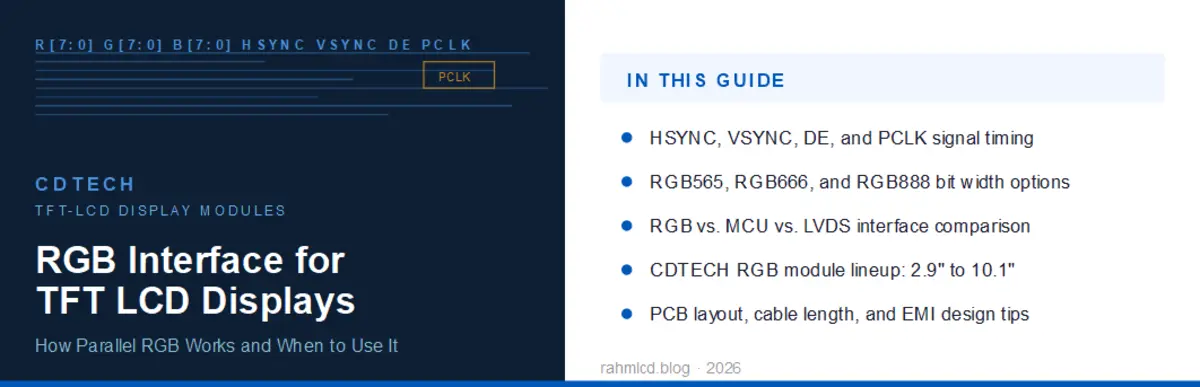
| RGB parallel | MCU/SoC direct drive, short distance | Under 20 to 30cm | 2.4″ to 7″ |
| SPI / MCU | Low-speed, simple microcontroller projects | Short | 2.4″ to 5″ |
| LVDS | Industrial, vehicle, longer cable runs | Up to 50 to 100cm | 7″ to 15.6″ |
| MIPI DSI | Mobile SoCs, Raspberry Pi, compact embedded | Short, on-board | 3.5″ to 10.1″ |
| HDMI (with adapter) | Single-board computers, plug-and-play host | Standard HDMI | 7″ to 15.6″ |
The interface is constrained by your host processor or SoC. If your processor outputs MIPI DSI and your display is LVDS, you need a bridge chip between them: an additional component, additional cost, and an additional failure point. Confirming interface compatibility before selecting a display saves a significant amount of design iteration.
Brightness: what the spec sheet number actually means in your application
Backlight brightness is specified in nits (candelas per square metre). A standard indoor display runs at 200 to 400 nits. A display intended for factory floor use typically needs 500 to 800 nits. Applications near windows, in vehicle cabs, or in partially outdoor environments need 800 to 1200 nits. Full outdoor or worst-case sun exposure requires 1000 nits minimum, with anti-reflective coating on top.
The nits number on the datasheet is the backlight output measured at the module face under controlled conditions. By the time light passes through a cover glass, a touch panel, and any optical bonding layers, the effective brightness at the viewer is lower. For any application where the display will face significant ambient light, specify the brightness based on the worst-case installation environment rather than the average.
Higher brightness also means higher power consumption and more heat. For battery-powered or enclosed applications, the thermal and power budget implications of a high-brightness module are worth calculating before the design is locked.
For a detailed breakdown of brightness thresholds by environment, including outdoor and vehicle-mounted applications, see our guide on sunlight readable LCD displays.
Touch panel options: CTP vs RTP
Most TFT LCD modules are available with an optional integrated touch panel. The two main technologies have meaningfully different characteristics in industrial and medical applications.
Capacitive touch (CTP, specifically PCAP) is the default for most modern applications: multi-touch support, fast response, durable glass surface. It requires a conductive input, meaning bare fingers or thin capacitive-compatible gloves. It is also susceptible to interference from strong electromagnetic fields, which matters in motor-driven industrial environments.
Resistive touch (RTP) responds to physical pressure regardless of the input type: thick gloves, stylus, non-conductive tools. It has no EMI sensitivity and is more tolerant of liquid contamination. The limitation is single-touch input only and a softer top surface that wears faster than glass.
For a full comparison including application-specific guidance, see our guide on capacitive vs resistive touch panels.
Size and aspect ratio
TFT LCD modules are available across a wide size range. CDTECH supplies modules from 2.4 to 15.6 inches, covering standard aspect ratios (16:9, 16:10, 4:3) as well as bar-type formats with aspect ratios of 3:1 and wider.
Size selection is usually determined by the enclosure cutout dimensions and the UI content density. Two other constraints that come up frequently:
- The FPC exit direction. The flexible cable connecting the module to the driver board exits from a specific edge of the panel. If the FPC exit conflicts with the enclosure structure, the solution usually involves folding the FPC around the module frame, which adds mechanical complexity. This is worth confirming before the enclosure is tooled.
- Viewing angle. Standard TN panels have narrow vertical viewing angles. IPS panels provide wide, symmetric viewing angles in both axes. For any application where the display is viewed from off-axis, particularly panel-mount installations viewed from below by standing operators, IPS is the more reliable choice.
For industrial and AGV applications specifically, where brightness, viewing angle, and EMI tolerance all matter, our industrial touch screen monitor guide covers the full specification process.
For bar-type and stretched formats used in audio equipment and industrial status displays, see our stretched bar LCD sizing guide.
What changes between a standard module and a custom one
A standard module is a production item: defined specifications, existing tooling, available from stock or with a standard lead time. A custom module involves one or more changes to the standard configuration that require engineering work and tooling cost.
Common customisation requests we handle:
- Backlight brightness adjustment, either higher for outdoor use or lower for power-constrained applications.
- FPC length, exit direction, or connector type changes to fit a specific enclosure layout.
- Touch panel integration with a specific controller IC for glove mode or water rejection tuning.
- Optical bonding of cover glass or touch panel to the LCD, reducing internal reflections and improving outdoor readability.
- Custom bezel dimensions or mechanical frame modifications for non-standard enclosure cutouts.
Customisation at the module level requires volume commitment. Our standard minimum order quantity for production runs is 1,000 units. Below that threshold, standard catalogue modules are the practical option. Development samples are available in small quantities for design validation before committing to production volume.
Industries and applications
The modules we supply go into a wide range of applications. The most common categories in our customer base:
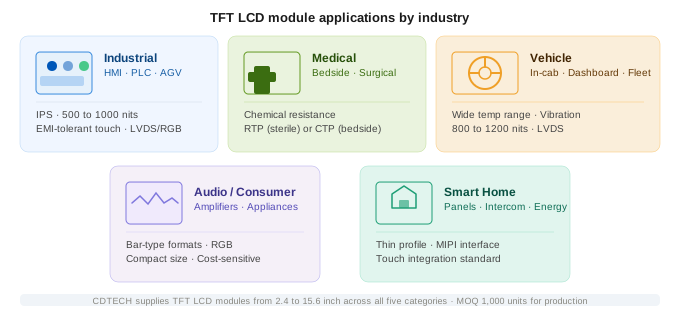
| Industry | Typical application | Key requirements |
|---|---|---|
| Industrial automation | HMI panels, PLC interfaces, AGV displays | IPS viewing angle, 500 to 1000 nits, EMI-tolerant touch |
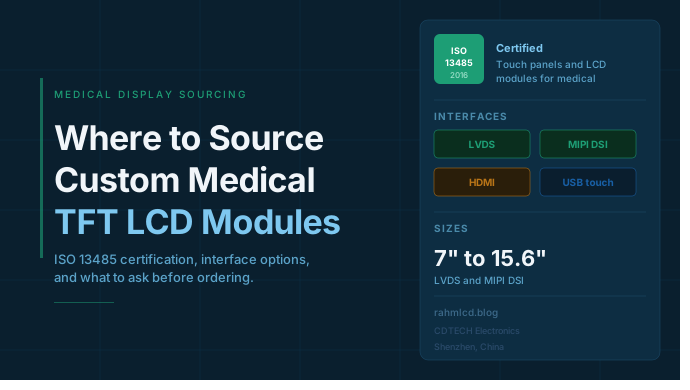
| Medical devices | Bedside monitors, surgical equipment interfaces | Chemical resistance, RTP or CTP depending on sterility requirements |
| Vehicle and special vehicles | In-cab displays, dashboard HMI, fleet telematics | Wide temperature range, vibration tolerance, high brightness |
| Consumer electronics and audio | Audio equipment front panels, smart appliances | Compact size, bar-type formats, RGB interface |
| Smart home devices | Control panels, intercom displays, energy monitors | Thin profile, MIPI interface, touch integration |
What to confirm before you specify
- What interface does your host processor output, and does the module support it natively or through a bridge?
- What is the worst-case ambient light level at the installation location, and what brightness is required to maintain readable contrast?
- Is touch required? If yes, will the operator use bare hands, gloves, or a stylus, and is the environment high-EMI?
- What is the operating temperature range, including enclosure heat buildup?
- Does the FPC exit direction and length work within your enclosure layout?
- What is the expected production volume, and does it meet the MOQ for the configuration you need?
Frequently Asked Questions
What is the difference between a TFT LCD panel and a TFT LCD module?
A TFT LCD panel is the bare glass component only. A TFT LCD module adds the backlight, driver IC, FPC, and interface connection, making it ready to integrate directly into your device without additional assembly.
What interfaces do TFT LCD modules support?
Common interfaces include RGB, SPI, MIPI DSI, LVDS, and HDMI. The right choice depends on your host processor output. MIPI and RGB are typical for smaller modules under 7 inches; LVDS is standard for larger industrial displays from 7 to 15.6 inches.
What is the minimum order quantity for a TFT LCD module?
CDTech’s standard MOQ for production runs is 1,000 units. For design validation before committing to production, development samples are available in small quantities.
Can I get a TFT LCD module with a touch panel included?
Yes. Both capacitive touch (CTP) and resistive touch (RTP) options are available, either bonded or unbonded to the module. CTP is standard for most applications; RTP is recommended for gloved-hand operation or high-EMI environments.
How long does TFT LCD module customization take?
Typical lead time is 4 to 6 weeks after sample confirmation, depending on component availability and the scope of customization required.
What brightness level do I need for outdoor or high-ambient-light use?
For full outdoor exposure, a minimum of 1,000 nits is recommended, combined with an anti-reflective coating. Partial outdoor or near-window installations typically require 800 to 1,200 nits. Standard indoor use runs at 200 to 400 nits.
Have a specific module requirement? Share your application, display size, interface, and volume estimate and we can confirm availability and lead time, or recommend an alternative if the exact spec is not in our standard range. Contact us here.

 English
  Español
  日本語
日本語  한국어
한국어
Leave a Reply