Most custom LCD display projects do not fail because of bad engineering. They fail because the supplier relationship was not established clearly enough before the design was locked. The drawing gets approved, tooling starts, samples arrive, and then the problems surface: a parameter nobody confirmed, a lead time nobody accounted for, a cost model that changes after the NRE is paid.
This guide covers what to evaluate in a custom LCD display supplier before you commit, and what questions to ask before the project starts. For a broader overview of TFT LCD module specifications and configuration options, see our complete TFT LCD module guide.
What custom actually means in LCD module development
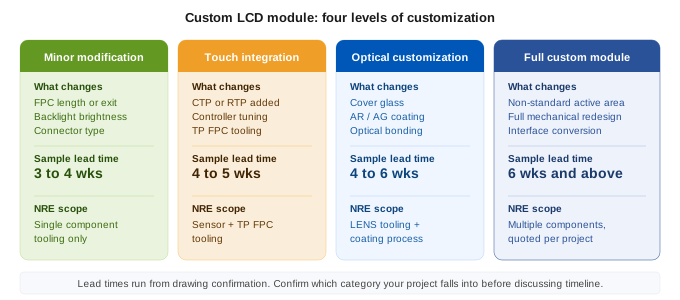
Custom is not one thing. It covers a wide range of project types, and the scope determines the cost, the lead time, and the supplier you need.
| Customization type | What changes | Typical sample lead time |
|---|---|---|
| Minor modification | FPC length or exit direction, backlight brightness adjustment, connector type | 3 to 4 weeks |
| Touch panel integration | CTP or RTP added to a standard module, controller tuning | 4 to 5 weeks |
| Optical customization | Cover glass, AR/AG coating, optical bonding | 4 to 6 weeks |
| Full custom module | Non-standard active area, full mechanical redesign, interface conversion | 6 weeks and above |
The first question to ask any supplier is which category your project falls into. A supplier who treats a minor FPC modification the same as a full custom project either does not understand the scope or is padding the timeline. A supplier who treats a full custom project as a minor modification is underestimating what is involved.
The questions that separate capable suppliers from the rest
Do they have long-term supplier relationships, or are they constantly rebidding?
LCD module manufacturers do not produce individual components in-house. FPC, frames, backlight assemblies, cover glass, and touch panels all come from specialized component suppliers. The module manufacturer designs the configuration, coordinates the tooling process with each supplier, and handles assembly and QC. This is the standard model across the industry.
What separates capable suppliers is the depth of those component relationships. In Shenzhen’s LCD supply chain, the strongest module manufacturers operate within a close-knit network of component suppliers who have worked together for years. These suppliers share pricing intelligence, raw material information, and production capacity in ways that a transactional bidding model cannot replicate. When a project requires a non-standard FPC geometry or a specific optical coating, a supplier with established relationships can get it done. A supplier who rebids every component from scratch faces longer timelines and less predictable outcomes.
The practical test is simple: ask how long they have worked with their FPC, optical, and mechanical component suppliers. A supplier who can name specific long-term partners and explain how those relationships affect their lead times is telling you something real. For more on how this supply chain model works in practice, see our post on the custom LCD supply chain.
What is the NRE structure?
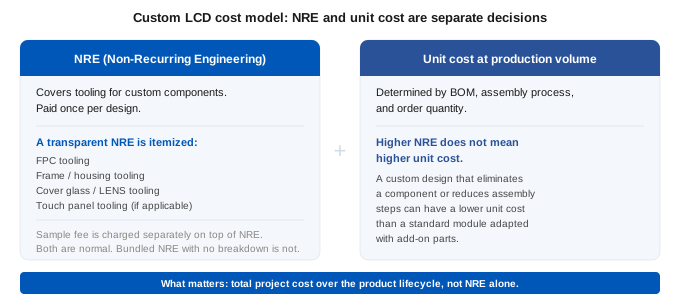
NRE, non-recurring engineering, covers the cost of designing and tooling the custom components. A transparent supplier will itemize the NRE by component: FPC tooling, frame tooling, cover glass tooling, and so on. This matters because if a revision is needed after samples, you need to know which tooling item is affected and what it costs to redo. A bundled NRE figure with no breakdown makes revision costs unpredictable.
Sample fees apply on top of NRE in most cases. The NRE covers tooling. The sample fee covers material and assembly for the first units. Both are normal. What is not normal is an NRE fee that keeps growing after the scope was agreed.
Can they show you what they have shipped for similar applications?
References matter more in custom work than in standard product sales. A supplier who has shipped custom bar LCD modules for audio equipment understands the tolerance requirements and the interface constraints that come with that application. A supplier who has never done it is learning on your project. Ask for application references in your specific industry or for similar active area dimensions.
What happens after samples?
The sample is not the end of the project. Production tooling, production pricing, production lead time, and minimum order quantity all need to be confirmed before the sample phase begins. A supplier who cannot give you a clear production MOQ and lead time at the start of the project is not ready to be your production partner.
What to have ready before the first conversation
Suppliers who receive complete information at the start can give you a meaningful answer within days. Suppliers who have to chase down specs lose weeks, and so do you.
- Active area dimensions. The optical and mechanical specification that everything else is designed around.
- Interface type and pinout. What your host processor or SoC outputs natively. If it does not match a standard interface, say so upfront.
- Brightness requirement. The worst-case ambient light level at the installation location, not the average.
- Touch requirement. Whether touch is needed, what input method the operator uses, and whether the environment has EMI, liquid contamination, or temperature extremes that affect touch technology choice. Our guide on capacitive vs resistive touch panels covers this in detail.
- Operating temperature range. Particularly for vehicle and industrial applications where the thermal environment at the display location may exceed standard commercial ratings.
- Target production volume and timeline. When does the design need to be locked, and what is the annual production volume at steady state.
The cost model you should expect
Custom LCD module pricing has two components: NRE and unit cost.
NRE covers the tooling for any custom components. For a minor modification like an FPC change, the NRE is relatively small, typically covering just the flex circuit tooling. For a full custom module with a new frame, backlight, and cover glass, the NRE covers multiple tooling items and is correspondingly higher.
Unit cost at production volume is separate. It is determined by the bill of materials, the assembly process, and the order quantity. A higher NRE does not always mean a higher unit cost. A custom design that eliminates a component or reduces assembly steps can have a lower unit cost than a standard module adapted with add-on parts.
The ratio that matters is total project cost over the product lifecycle. A higher NRE that delivers a better-fit module at lower unit cost often wins over a lower NRE that requires ongoing adaptation costs in the field.
Production MOQ and what it signals
Our standard production MOQ for custom modules is 1,000 units per order. This is not an arbitrary number. It reflects the minimum run size where production tooling, material procurement, and quality control can be managed efficiently without passing excessive overhead cost to the customer.
A supplier with no stated MOQ for custom work is either working with very flexible contract manufacturers or is not being transparent about the true minimum. A supplier with an MOQ significantly above 1,000 units for a standard custom configuration may be more suited to high-volume consumer electronics than to industrial or commercial applications with more modest volumes.
When standard is better than custom
Custom development makes sense when no standard module meets the requirements. It does not make sense when a standard module is close enough and the customization adds cost without proportional benefit.
The situations where standard is usually the better choice:
- The required active area matches a standard size within a few millimeters and the enclosure can be adjusted.
- The interface mismatch can be resolved with a bridge chip at lower cost than retooling.
- The production volume is below the threshold where NRE amortization makes economic sense.
A supplier worth working with will tell you when a standard module is the right answer. If a supplier pushes custom work on every inquiry regardless of fit, that is a signal about their business model rather than your project requirements.
If your project involves replacing a discontinued module rather than developing a new one, the evaluation process is different. Our guide on LCD display EOL replacement covers the specific steps for that scenario.

 English
  Español
  日本語
日本語  한국어
한국어
Leave a Reply