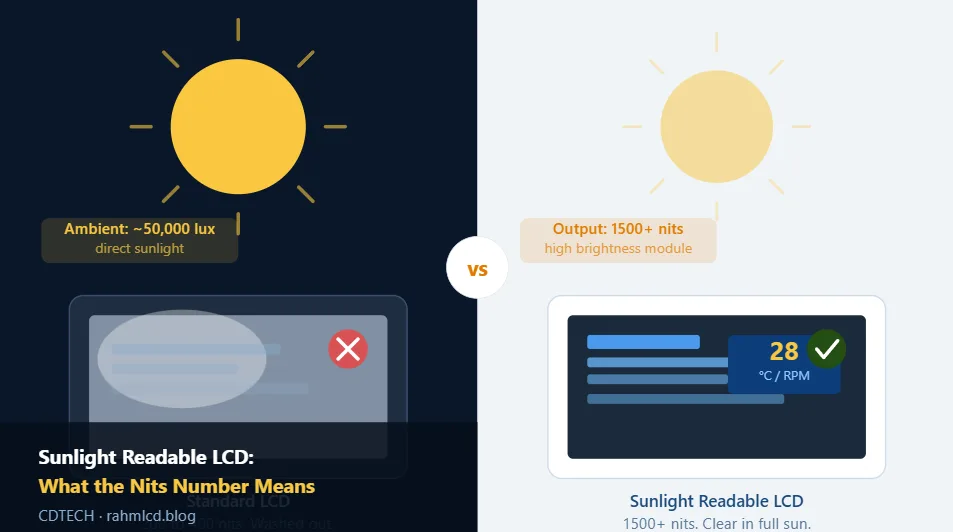
This guide explains how to specify a sunlight readable LCD display for outdoor and vehicle-mounted applications, covering backlight brightness, anti-reflective coating, and operating temperature range.
The spec sheet says 1000 nits. The customer asks if the screen is readable outdoors. These two pieces of information should connect directly, but in practice they often do not. “Nits” is a measurement of backlight output, not a promise of outdoor readability. Whether that number is enough depends on several other factors that rarely appear on a datasheet.
This article explains what sunlight readable actually means in practice, where the common failure points are, and what to look for when specifying a display module for outdoor or vehicle-mounted applications. For a broader overview of TFT LCD module types and configuration options, see our complete TFT LCD module guide.
Why standard displays fail in sunlight
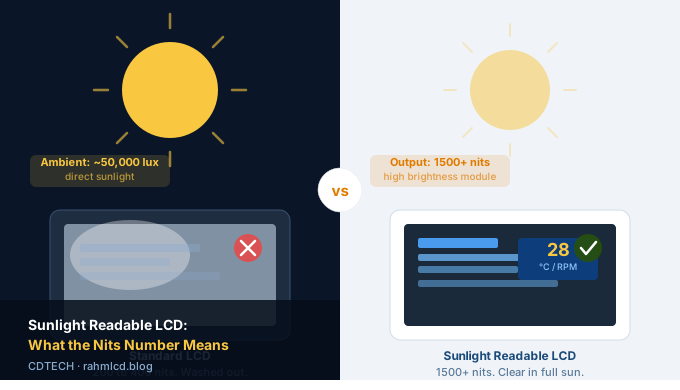
A typical consumer LCD panel outputs somewhere between 200 and 400 nits. Direct sunlight on a surface measures roughly 10,000 to 100,000 lux depending on conditions. A standard display in full sun produces a washed-out, near-invisible image because the ambient light reflected off the screen surface overwhelms the backlight output entirely.
The problem has two separate components. First, the backlight is simply not bright enough to compete. Second, the cover surface reflects ambient light back at the viewer. Both need to be addressed. A very bright backlight behind a highly reflective surface still produces a poor outdoor image. This is why “high brightness” and “sunlight readable” are related but not interchangeable terms.
What the nits number actually tells you
Nits (cd/m²) measure luminance: the brightness of light emitted or reflected from a surface toward the viewer. For outdoor display applications, the general thresholds look like this:
| Brightness range | Typical use case | Notes |
|---|---|---|
| 200 to 400 nits | Indoor, controlled lighting | Standard commercial LCD range |
| 500 to 800 nits | Bright indoor, shaded outdoor | Marginal in direct sun |
| 800 to 1000 nits | Semi-outdoor, vehicle cab | Workable with AR coating |
| 1000 to 1500 nits | Outdoor industrial, marine | Recommended starting point for open environments |
| 1500+ nits | Full sun, high-altitude, desert environments | Required for worst-case outdoor conditions |
These thresholds assume reasonable anti-reflective treatment. Without it, even a 1500-nit panel can underperform a 1000-nit panel with good optical surface treatment in the same environment.
The three things that actually determine outdoor readability
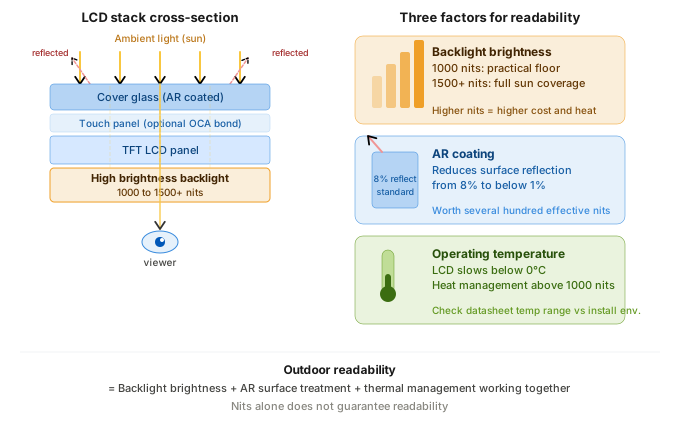
1. Backlight brightness
This is the most direct lever. Higher output backlight modules drive more light through the LCD stack toward the viewer. The cost and power consumption increase with brightness, and thermal management becomes more critical above 1000 nits. For most outdoor industrial and vehicle-mounted applications, 1000 to 1500 nits covers the majority of real-world conditions. Above 1500 nits is typically needed for applications in consistently bright environments: open-deck marine, agricultural equipment in high-sun regions, outdoor kiosks with no shade canopy.
2. Anti-reflective (AR) surface treatment
An untreated glass surface reflects roughly 8
A panel with good surface treatment and moderate brightness will often outperform a brighter panel with poor surface treatment in the same outdoor environment. When reviewing specifications, check for both the nits number and whether AR coating or optical bonding is included or available as an option.
3. Operating temperature range
Outdoor displays face temperature extremes that indoor panels do not. LCD response time degrades in cold, typically below 0°C, and the backlight output can shift. At high temperatures, sustained high-brightness operation generates significant heat that needs to be managed through enclosure design or active cooling. A display specified at 1200 nits at 25°C may derate substantially at 70°C ambient. For vehicle-mounted applications especially, the operating temperature range under the datasheet section is worth checking carefully against the expected in-cab or under-hood environment.
A note on UV exposure and long-term outdoor reliability
Brightness and readability are the most visible requirements for outdoor displays. UV resistance is less visible but matters just as much for long-term field reliability.
Prolonged UV exposure degrades polarizer films, adhesive layers, and cover materials over time. The degradation shows up as yellowing, delamination, reduced contrast, and eventually display failure. This is particularly relevant for applications where the display faces direct sunlight year-round: outdoor industrial equipment, marine consoles, agricultural machinery.
The relevant test standards are DIN 75220 and ISO 4892-3, which define standardized UV aging procedures for automotive and industrial environments. It is worth noting that these certifications typically sit with the end product, not the display module itself. The system integrator or equipment manufacturer runs the qualification, not the module supplier. What matters from the module side is whether the materials and construction will hold up when the product goes through that process. For outdoor applications with a multi-year field life expectation, this is worth confirming with your display supplier before the design is finalized rather than during a warranty review.
What to confirm before specifying an outdoor LCD module
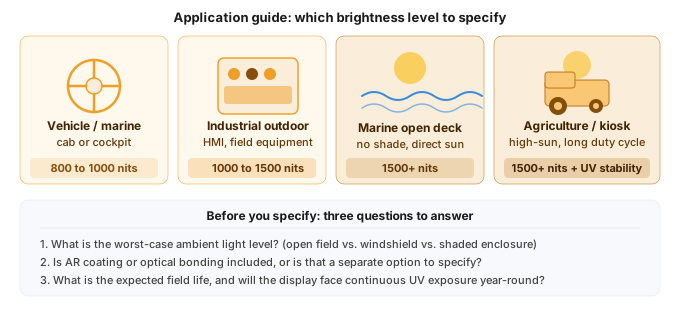
- What is the worst-case ambient light level the display will face? Direct sun in an open field is different from sun through a vehicle windshield or a partially shaded enclosure.
- Is the brightness spec measured at the module output, or at the system level after cover glass and touch panel? Each layer adds loss.
- Is AR coating included, or is the cover glass standard reflectance? Is optical bonding available?
- What is the operating temperature range, and does it cover the expected thermal environment including solar load on the enclosure?
- What is the expected field life, and will the display face continuous UV exposure? If yes, ask for UV test certification documentation.
- Is touch required for the outdoor application? Touch technology choice affects outdoor reliability. For a comparison of capacitive and resistive options in demanding environments, see our guide on capacitive vs resistive touch panels.
- For vehicle or marine applications: is the module rated for the vibration and humidity levels of the installation environment?
Summary
Sunlight readability is not a single spec. It is the result of backlight brightness, surface treatment, and thermal management working together. The nits number is the starting point, not the complete answer. For most open outdoor applications, 1000 nits is the practical floor with AR treatment. For consistently bright environments or long field-life requirements with UV exposure, 1500+ nits covers the majority of demanding cases.
For vehicle-mounted and marine applications, confirm the operating temperature range and ask about optical bonding options. For any outdoor deployment expected to last several years, UV certification is worth verifying before committing to a module.
Working on an outdoor or vehicle-mounted display project? Share the application environment, required brightness level, and expected field life and we can suggest a module configuration based on what we have shipped for similar use cases. Contact us here.

 English
  Español
  日本語
日本語  한국어
한국어
Leave a Reply