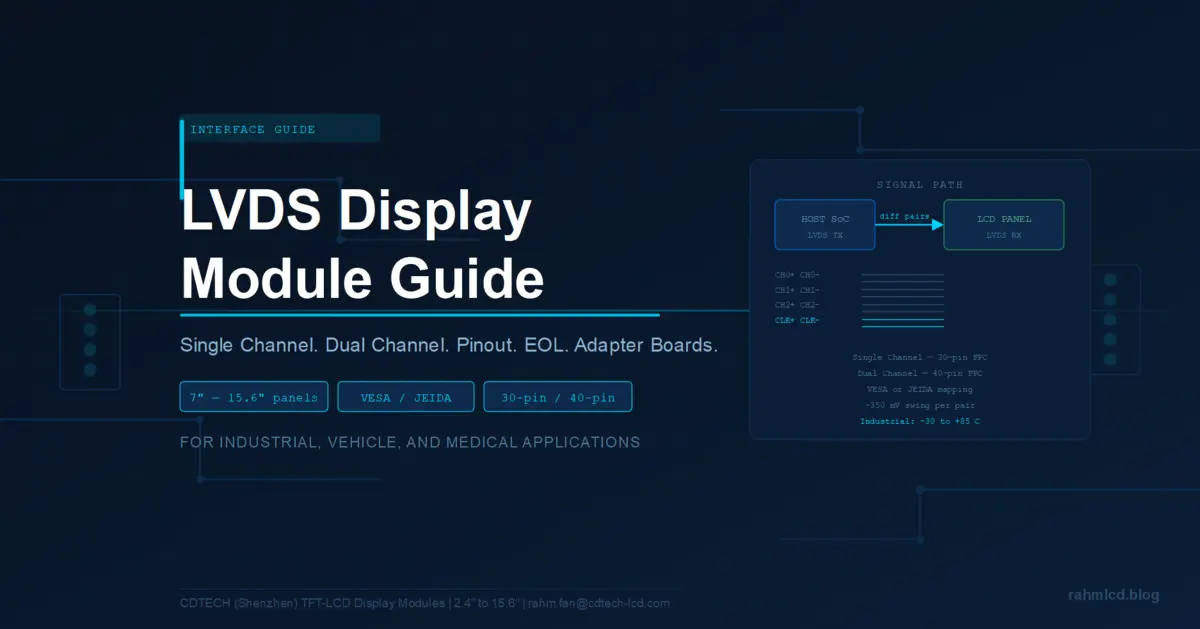
LVDS gets called outdated fairly often. Engineers who spend most of their time with MIPI or eDP look at it and see a 1990s-era parallel differential interface. But if you are specifying an LVDS display module anywhere in the 7 to 15.6 inch range for an industrial, vehicle, or medical application, it is almost certainly on your short list, and with good reason. The installed base of LVDS-capable host chips is enormous, the interface tolerates electrical noise well, and the ecosystem of panels, cables, and driver boards is mature. This article is a practical reference for engineers deciding whether an LVDS display module fits their project, and what to watch for when specifying or replacing one.
For a broader look at how LVDS compares to RGB, MIPI DSI, and eDP across different panel sizes, see the TFT LCD Module guide, which covers interface selection in more detail.
Why LVDS Is Still the Default Interface in Industrial LCD Modules
When engineers evaluate an LVDS display module for a new design, the first question is usually why LVDS rather than something newer. The answer comes down to three things: noise immunity, cable length tolerance, and host chip support.
LVDS, Low-Voltage Differential Signaling, transmits data as differential pairs rather than single-ended signals. The receiver looks at the voltage difference between the two wires in each pair, not the absolute voltage level. Common-mode noise, the kind that couples in from power lines, motors, or adjacent switching circuits, affects both wires equally and largely cancels out. That property makes LVDS well suited for industrial enclosures and vehicle electronics, where EMI is a routine challenge rather than an edge case.
The practical result is that LVDS panels can run longer cable assemblies than parallel RGB without picking up visible noise artifacts. A 30 cm FPC run that might cause pixel jitter with RGB at higher resolutions is routine for LVDS. That gives mechanical designers more flexibility in placing the display module relative to the host board.
On the host side, LVDS output is natively supported by a wide range of industrial SoCs: NXP i.MX series, Rockchip RK3568 and RK3288, Texas Instruments Sitara AM335x and AM57xx, Allwinner A-series, and many others. These processors ship in millions of industrial and embedded devices. The driver support and reference designs already exist, which reduces bring-up risk compared to migrating to eDP or MIPI for a panel size where LVDS works fine.
MIPI DSI has largely taken over below 7 inches, and eDP is common above 13 inches in notebook-style enclosures. But in the 7 to 15.6 inch segment, LVDS remains the dominant choice in production hardware. The interface is not going away for this category.
Single Channel vs Dual Channel LVDS: How to Decide
LVDS transmits pixel data serially over multiple differential pairs. A single channel implementation uses four data pairs plus one clock pair. Dual channel doubles that to eight data pairs and two clock pairs, which roughly doubles the available pixel bandwidth. When you request an LVDS display module, the channel count is one of the first parameters to resolve.
The practical cutoff falls around 1280×800 (WXGA) at 60Hz. Panels at or below that resolution typically use single channel LVDS. Common examples include the 7 inch modules at 800×480 and 1024×600, 9 inch at 1024×600, 10.1 inch at 1024×600 or 1280×800, 10.4 inch at 1024×768, and 12.1 inch at 1280×800.
Dual channel is required once the pixel count climbs above what single channel can handle at the target refresh rate. In practice that means 1920×1080, 1920×1200, or 1920×720 bar-type formats. The 12.3 inch bar LCD at 1920×720, 12.8 inch FHD at 1920×1080, 13.3 inch FHD, 15 inch bar at 1920×720, and 15.6 inch FHD panels all use dual channel LVDS. For stretched bar LCD panels in vehicle and industrial applications, see the stretched bar LCD guide, which covers their size and interface options in detail.
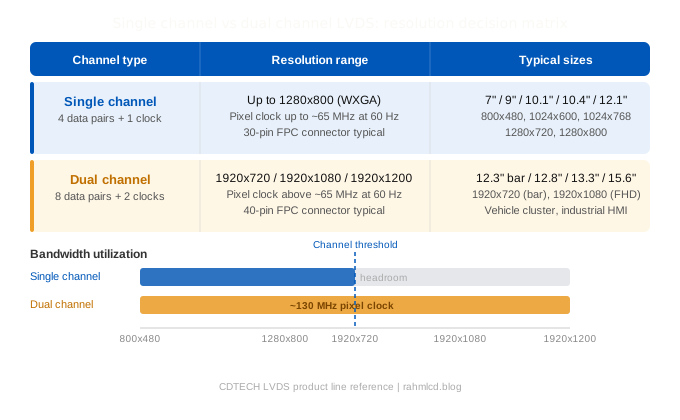
The channel count also determines the connector. Single channel LVDS display module designs most commonly use a 30-pin FPC. Dual channel panels typically require a 40-pin FPC to carry the additional data pairs. Mismatching connector pin counts is one of the first things that trips up engineers sourcing a replacement panel.
LVDS Connector and Pinout Basics
The physical connector on most LVDS display module designs is a flexible printed circuit, either 30-pin or 40-pin at 0.5mm pitch. Some older industrial panels used 1.0mm pitch, which is worth checking if you are sourcing a direct board-to-panel connection without an intermediate FPC.
FPC exit direction matters more than engineers often expect at specification time. A bottom-exit FPC folds neatly toward the rear of the display when the module is mounted in a horizontal orientation. A right-angle or top-exit FPC requires more clearance behind the module and may conflict with chassis features if not accounted for early. This is one of the details worth resolving during the mechanical design phase rather than at prototype. CDTECH can customize FPC length and exit direction on production quantities. See the custom LCD OEM article for details on what is practical to modify.
Beyond the physical connector, the two dominant pin assignments are VESA and JEIDA. These define which differential pair carries which channel, the bit ordering within each serialized data stream, and the location of auxiliary pins like TSTSEL and MODE. An LVDS display module wired to the VESA mapping will display scrambled or inverted colors if connected to a host configured for JEIDA, and vice versa. In some cases the panel will not initialize at all.
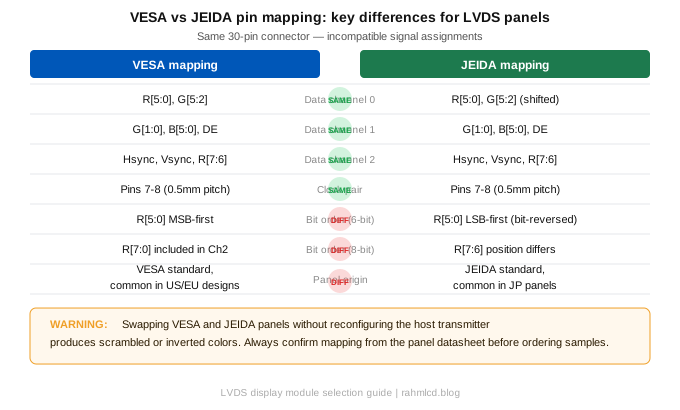
Most modern industrial SoCs and LVDS transmitter ICs allow software configuration of VESA vs JEIDA mode. But that only helps if you know which mapping the panel expects. The datasheet should state it explicitly. If it does not, ask the supplier before ordering samples.
Other pin assignments that vary between manufacturers include: the number of data bits per channel (6-bit or 8-bit panels use the same physical connector but different signal definitions), power sequencing pin behavior, backlight enable polarity, and whether certain reserved pins are tied high or low internally. None of these are visible from the outside. They live in the panel datasheet.
LVDS in Vehicle Applications
Vehicle environments are electrically hostile. Engine management, motor drives, solenoids, and ignition systems all inject noise into the power bus and, to some extent, into the chassis. An LVDS display module handles this better than most alternatives for the 7 to 15.6 inch size range.
LVDS differential signaling tolerates vehicle EMI well. The swing voltage is low, typically around 350mV, which also reduces radiated emissions from the display cable, a relevant concern for electromagnetic compatibility testing. That combination of noise immunity and low emissions has kept LVDS firmly in vehicle dashboard and infotainment designs long after consumer devices moved to MIPI.
Most vehicle-grade ARM SoCs used in instrument clusters, central information displays, and rear-seat entertainment include native dual-channel LVDS output. Typical panel sizes in these applications run from 7 inch dashboard indicators at 800×480 through 10.1 inch infotainment panels at 1280×720 or 1280×800, up to 12.3 inch wide-format panels at 1920×720 for combined cluster and center stack layouts. Industrial temperature grade panels (-30 to 85 degrees C) are standard for these applications rather than optional.
For a broader view of display selection in vehicle and special vehicle applications, including interface options and brightness requirements, the vehicle display article covers that territory in more depth.
LVDS to HDMI Adapter Board: When and How It Is Used
Some host systems output HDMI rather than native LVDS. Single-board computers like the Raspberry Pi series, many industrial SBCs, and video processing boards often expose HDMI as the primary display output. If the target LVDS display module uses an LVDS input, a conversion board is needed between the host and the panel.
An LVDS to HDMI adapter board accepts HDMI input and outputs LVDS in the correct format for the target panel. Common use cases include audio mixing consoles with an SBC running the UI firmware, industrial HMIs built on commercial SBCs, and vehicle infotainment prototypes using HDMI-out compute modules before migrating to a custom carrier board. We supply pre-mounted adapter boards on select modules, and this is something worth asking about when requesting a quote if your host outputs HDMI.
The integration details matter. An adapter board typically adds 5 to 15mm to the display stack depth, depending on connector placement and board layout. It requires its own power supply input, usually 5V or 12V, which needs to be routed from the system. The HDMI input carries EDID from the panel to the host, so the host’s display controller sees the panel resolution and timing through the adapter. That normally works without driver modification, but it is worth verifying with the adapter supplier for non-standard timing configurations.
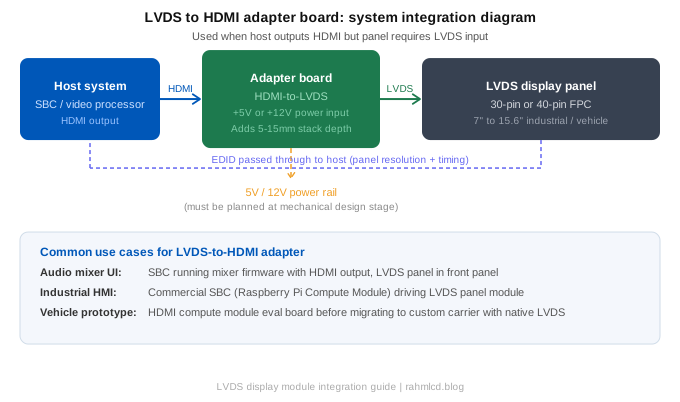
The main cost of using an adapter board is BOM complexity and stack height. If the final product design uses a custom carrier board, migrating to native LVDS output from the SoC typically makes more sense for production. But for prototyping, evaluation, or low-volume production where the host is HDMI-only, a well-matched adapter board is a practical solution.
EOL Replacement: LVDS Pinout Compatibility Is Not Guaranteed
Panel EOL (end of life) is a routine occurrence in long-running industrial products. The original panel goes out of production, and procurement needs to find a replacement with the same size, resolution, and interface. When sourcing an LVDS display module for EOL replacement, the common trap is assuming that matching size, resolution, and connector count means the replacement will work without hardware modification.
It usually does not. Two 10.1 inch, 1280×800, single channel panels from different manufacturers may use different VESA or JEIDA pin mappings. They may differ in power-on sequencing requirements, backlight enable polarity, or reserved pin tie states. A 6-bit panel and an 8-bit panel share the same physical connector but assign data to the differential pairs differently. Bit ordering within the serialized stream is not standardized across all manufacturers.
The minimum verification steps before committing to an LVDS replacement: compare VESA vs JEIDA mapping, confirm bit depth (6-bit or 8-bit), check power sequencing timing against your display controller’s capabilities, and verify backlight enable polarity. Any of these mismatches can result in a non-functional display or one that works intermittently. For a detailed process covering LVDS pinout verification as part of a broader EOL replacement workflow, see the LCD display EOL replacement guide.
How to Specify an LVDS Display Module
When requesting a quote or comparing panels, a complete specification prevents the most common sourcing mistakes. The checklist below covers the key parameters for any LVDS display module inquiry.
- Panel size (inches): The diagonal measurement. Be precise, as 10.0 and 10.1 inch may describe different active area dimensions from different manufacturers.
- Resolution: Width x height in pixels. This determines whether you need single or dual channel. At 1280×800 and below: single channel. At 1920xN: dual channel.
- Channel count: Confirm single or dual explicitly with the supplier, especially for resolutions near the boundary.
- Connector type and pin count: 30-pin or 40-pin, at 0.5mm or 1.0mm pitch. State what your carrier board already has if replacing an existing panel.
- FPC exit direction: Bottom exit, right-angle, or top exit. Confirm this against your chassis design early.
- Brightness: Standard (300 to 500 nits) for controlled indoor environments, high brightness (700 to 1000 nits) for bright factory floors or near-window installations, sunlight-readable (1000 nits and above) for vehicle-mounted or semi-outdoor use.
- Operating temperature: Standard -20 to 70 degrees C for most indoor applications. Industrial -30 to 85 degrees C for vehicle, outdoor, or harsh environment use.
- VESA or JEIDA pin mapping: Required if replacing an existing panel or connecting to a host with a fixed LVDS mapping. Verify against the host controller datasheet.
- Bit depth: 6-bit or 8-bit panel. Affects signal assignment on the connector.
- Adapter board: State whether the host outputs LVDS natively or requires HDMI-to-LVDS conversion. If an adapter is needed, resolve this before sample ordering.
Typical LVDS Display Modules
The following models represent commonly used LVDS display modules in industrial designs.
Working on a project that needs a specific LVDS display module size or configuration? Feel free to reach out. I am happy to help figure out what works best for your application, whether that is panel selection, adapter board options, or EOL replacement. 연락처: [email protected]
자주 묻는 질문
Can I connect a single channel LVDS panel to a dual channel LVDS output?
It depends on the host controller. Some LVDS transmitters can be configured to operate in single channel mode even when the silicon supports dual channel. If the host supports single channel mode in firmware or hardware configuration, connecting a single channel panel is possible. If the host is hardwired for dual channel output without a configuration option, it will not work without an adapter. Check the transmitter or SoC datasheet for this option before assuming either way.
What is the difference between LVDS and eDP?
eDP (Embedded DisplayPort) is a higher-bandwidth serial interface that operates over fewer physical wires using a more efficient encoding scheme. It is common in laptop panels and high-resolution industrial displays above 13 inches. LVDS uses parallel differential pairs with a simpler serialization method. eDP supports higher resolutions and higher refresh rates in a smaller connector, but requires newer SoC or transmitter hardware. For most industrial and vehicle panels in the 7 to 15.6 inch range, LVDS remains more widely supported across existing host platforms.
Is LVDS being phased out?
In consumer electronics and mobile, yes, MIPI and eDP have largely replaced it. In the industrial and vehicle segment for 7 to 15.6 inch panels, no. The installed base of LVDS-capable SoCs, the panel ecosystem, and the continued production of LVDS panels by major manufacturers all point to continued relevance for this category. Our product line includes LVDS display module options introduced in 2025 and 2026, including new models at 7 inch, 12.1 inch, and 15.6 inch.
How long can an LVDS FPC cable be?
For short FPC assemblies on the panel itself, practical lengths are typically 50 to 300mm without signal integrity problems at standard resolutions and refresh rates. Longer runs, up to 500mm, are possible with careful routing and controlled cable impedance. Beyond that, signal degradation becomes a factor, particularly at higher resolutions. If you need cable runs over 400mm, test with the actual cable assembly before finalizing the mechanical design.
Does CDTECH supply LVDS display modules with industrial temperature rating?
Yes. Several LVDS display modules in our current line carry industrial temperature grades, typically -30 to 85 degrees C. These include 7 inch, 8.0 inch, 10.1 inch, 12.1 inch, 12.3 inch bar, and 15.6 inch models. Temperature grade should be specified at inquiry time as not all sizes and resolutions are available in both standard and industrial grades simultaneously.

 한국어
한국어  English
  Español
  日本語
日本語
답글쓰기